Quick notes on Sidechains “Elements”

I’ve written a lot recently about the potential of replicated, shared ledgers that are private/semi-private. For example, I suggested that industries with duplicated systems across firms might get benefit from adopting this technology.  But I also keep an eye on what’s happening in the Bitcoin world.  So the BlockstreamElements” launch caught my attention this week.

I wrote about the idea behind sidechains late last year and so it’s interesting to see parts of the vision turn into real code. Back then, I said that a way to think about this is as a system that lets you “move” bitcoins from the Bitcoin blockchain onto another bitcoin-like system and back again in a way that doesn’t harm the Bitcoin network and doesn’t require you to trust a central entity like a Bitcoin exchange.

Why would you want to do that?

  • First, it could be a good way to prototype proposed changes to the core Bitcoin protocol with lower risk: the change could first be implemented and tested on a sidechain, a relatively safe environment. And, should the new system work well, those who needed the feature could transfer their coins to that sidechain, knowing they could bring them back again in the future.
  • Secondly, and looking further ahead, this approach could also provide a migration path for existing bitcoin holders to a new version of the network – offering an alternative to a hard-fork.

It’s an attractive idea and one can intuitively sense why it could be valuable. Of course, the idea is not perfect. Developers such as Peter Todd, have argued that sidechains would be vulnerable to attack under various circumstances. But, leaving that to one side for now, what was announced this week and what does it mean?

Sidechains Announcement

What follows is deliberately brief in order to share thoughts quickly:

  • A sidechain is now up and running and accessible from the Bitcoin testnet.
  • The sidechain can be thought of as “just like Bitcoin” (or just like Bitcoin testnet) but with several additional features, or “elements”.
  • These elements include features such as “confidential transactions” and “relative locktime” (full details here and I explore two in a little more detail below)
  • A mechanism for moving coins to and from the sidechain is up and running… but this mechanism currently relies on a network of semi-trusted oracles, or “functionaries”, to validate the return of coins to testnet. This is because the necessary changes to enable this in a decentralized fashion do not yet exist in Bitcoin and one should remember there is no guarantee such a change would ever happen
  • The sidechain is also currently secured by this network of functionaries”. I understand this is a temporary situation but one could argue it means the distinction between permissioned and permissionless ledgers could be becoming somewhat blurred. Preston Byrne of Eris Industries has said something similar.
  • The code is open source so other people could set up their own sidechains and run their own functionaries.
  • In what I think could be a smart move for gaining mindshare, blockstream have signed up several universities with Bitcoin projects/programmes, such as MIT and Princeton to run these “functionaries”.

Elements

The individual features being explored initially have been called “Elements

Of particular interest to my readers might be Confidential Transactions and Issued Assets.

Issued Assets is an attempt to add support for Colored Coins-style assets to the core protocol. This is the one feature that is not yet deployed to the sidechain but it is also one of the most intriguing. I’ll be watching for comment from those projects in the coming days.

Confidential Transactions are a very clever application of cryptography to hide the value of transactions whilst still allowing them to be fully validated by the network. If this works well, it could be a partial solution to the confidentiality issue faced by Replicated, Shared Ledgers.

The fundamental characteristic of these systems – both permissioned and permissionless – is that multiple copies of the ledger are maintained and that these copies are widely distributed. Without features like Confidential Transactions (or related technology such as ZeroCoin or ZeroCash), these systems may be  unsuitable for those with confidentiality and privacy requirements. Do you want everybody in the network knowing your positions?

Based on what I’ve read so far, I’m not sure this is a full solution – financial firms care about more than just the value of transactions – but it’s a good start.

Next Steps

The test for me in coming weeks will be the extent to which non-Blockstream developers engage with this and other sidechains. I’ll also be paying particular attention to the Bitcoin Dev mailing list to see if any debate begins about making changes to the core protocol to allow decentralised pegging to work directly.   [Update 2015-06-11 to correct pegging terminology. Thanks to joeykrug for the correction]
Towards a Unified Model for Replicated, Shared Ledgers

Don’t Say The “B Word”!

I’ve come to the conclusion that saying “blockchain” has become unhelpful. It just confuses people. It means too many different things to different people and so it’s almost impossible to have a conversation in this space without talking past each other. So, as I argued in this piece on permissionless ledgers and this piece on permissioned ledgers, it can be useful to talk in terms of replicated shared ledgerssince I think this gets to the heart of what unifies – and separates – these two worlds.

  • Shared: because multiple actors can read or write to different parts of the ledger
  • Replicated: because everybody who needs a copy can have a copy, rather than relying on a powerful central entity

In this piece, I try to bring it all together – to explain why we should be thinking about permissionless ledgers as a classic example of disruptive innovation and how I think banks could think about permissioned ledgers in the interim.

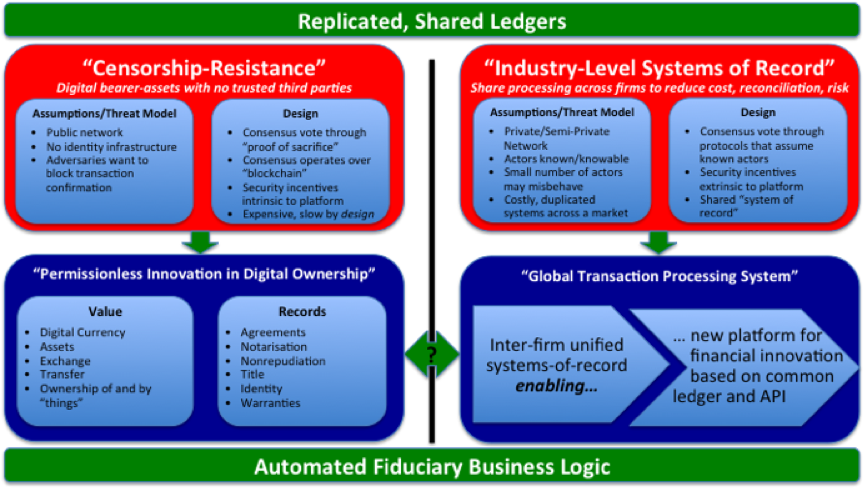
In what follows, I build up the model below from its constituent parts:

RSL5

A unified model of permissioned and permissionless ledgers?

Permissionless Ledgers: Censorship Resistance

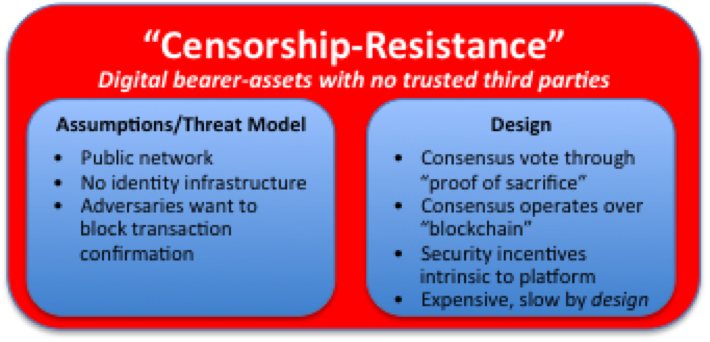
Let’s be clear: the breakthrough of Bitcoin was to create the closest system yet of “digital cash” – something that you can own outright and transfer to anybody else without permission. Its design flows naturally from that objective:

RSL1

Bitcoin’s design follows directly from its objectives. Its replicated, shared ledger is designed to enable the existence of a censorship-resistant digital bearer asset  

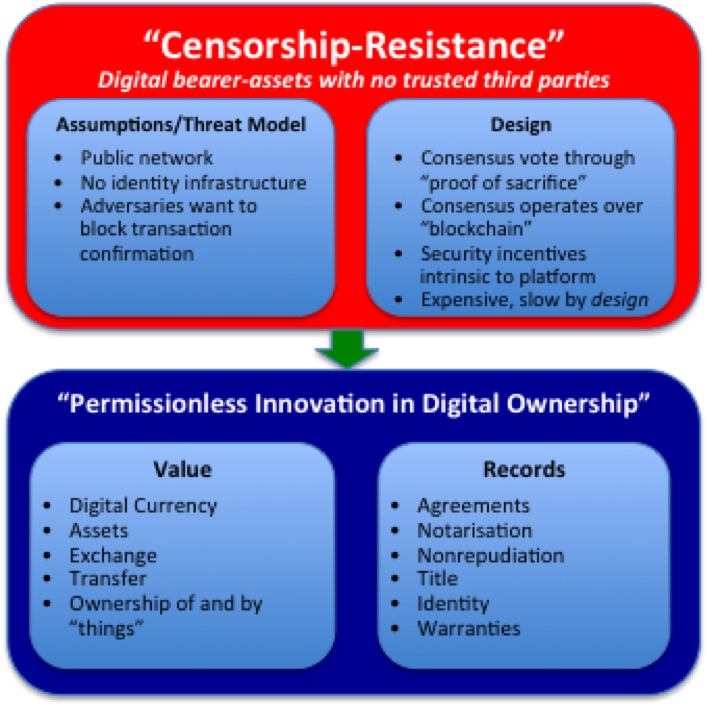
As I argued here, it’s little surprise that bankers and regulators look at it with deep suspicion! However, there’s a good reason why the smart observers aren’t dismissing it: censorship resistance implies an open, neutral platform that could be a driver of permissionless innovation:

RSL2

Censorship-resistance enables permissionless innovation in digital ownership  

So, it’s not a surprise that we’re seeing innovation and experimentation in the fields of value transfer – such as micro-micro payments (nanopayments?) for video content – and in the recording and execution of agreements.   This is, almost but not entirely, exclusively being driven by people from outside the traditional financial sector. They’re taking a platform that is, in most meaningful ways, slower and more expensive than today’s financial system and using it for novel purposes.

I think the smart firms are keeping an eye on this because they know how stories like this end:

“Disruptive innovations usually find their first customers at the bottom of the market: as unproved, often unpolished, products, they cannot command a high price. Incumbents are often complacent, slow to recognise the threat that their inferior competitors pose. But as successive refinements improve them to the point that they start to steal customers, they may end up reshaping entire industries” (The Economist)

Permissioned Ledgers: Industry-Level Systems of Record  

Notwithstanding the promise – or threat – of permissionless systems, I sense that many financial firms are looking closely at permissioned systems, by which I mean technologies that allow multiple firms to run a private, shared ledger of some sort.   What most people fail to ask is: why?! If you don’t have censorship-resistance as your business objective, why are you looking at this space at all?

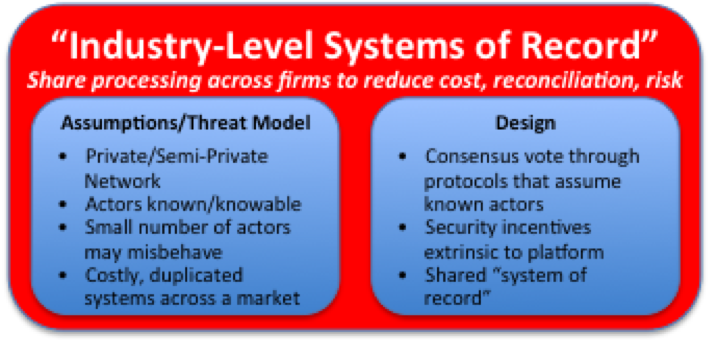
The answer, I argued, in this piece is that replicated, shared ledgers can also solve a different problem:   if you’re in an industry where multiple firms all run similar systems to keep track of records (account balances? derivatives positions? orders?) then you’re probably carrying cost you don’t need: everybody is paying to maintain these duplicated, non-differentiating systems. And, because they’re all slightly different, you need to reconcile them with each other all the time to make sure they agree.

So the argument for applying replicated, shared ledger technology to this problem is that you could mutualise the cost of running and securing a single logical ledger, copied across your firms so you each have your own copy and so aren’t reliant on a powerful central entity for access. So nothing to do with censorship-resistance and nothing to do with cryptocurrencies.   The idea, instead, is to move from each firm having its own systems of record to having systems of record at the level of the industry:

RSL3

Is the promise of permissioned ledger the possibility of industry-level systems of record without a powerful central gatekeeper?

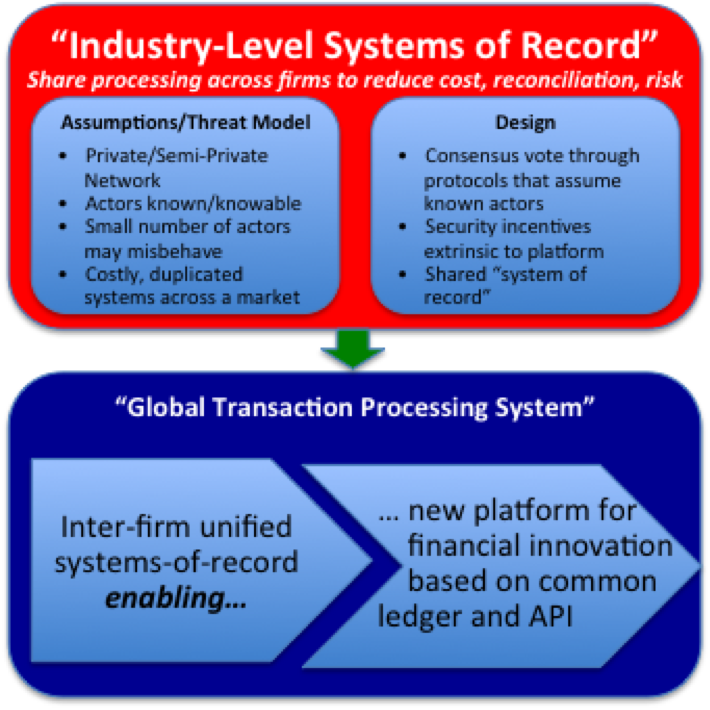
But we can take this thought-process further. Imagine such a platform existed: perhaps a replicated shared ledger that recorded all inter-bank balances or recorded all derivatives positions between firms.   What we would effectively have is a transaction processing system for that industry: if we all agree that this shared ledger is authoritative for records (e.g. who owes what to whom) then could we not also agree that this ledger is something to which we could deploy code that describes our agreements? Could this industry-level ledger also host inter-firm business logic? How much cost and complexity might that remove from firms?

RSL4

Is a common ledger between firms the enabler for a common transaction processing platform for an industry?

And this is where, I think, the two worlds – those of permissioned and permissionless ledgers – come back together:

Unifying the worlds of permissionless and permissioned ledgers

In the permissionless world, some of the most interesting developments are happening at the level of transaction scripting and smart contracts. The Ethereum project is the most obvious example, of course, but even projects like Streamium are showing how Bitcoin features can be used to create interaction models that simply aren’t possible on today’s financial platforms.

Similarly, and as I argued above, the driver of innovation on permissioned ledgers might be the migration of inter-firm business logic from individual firms to a shared ledger between firms: think of code that represents an agreement between two firms, that executes “on” a ledger, which can take custody of assets on that ledger and execute in response to external events: if both firms have signed it off in advance, suddenly they don’t need all the cost and expense of their own systems.  I wrote about this idea in my piece on smart contracts.

So we see that the two worlds of replicated, shard ledgers – permissioned and permissionless – might actually be leading us to the same place: a world where business logic for money – automated fiduciary code, if you like – is deployed to a shared ledger and run autonomously.    

RSL5

Perhaps the permissioned and permissionless worlds aren’t as different as they seem?