Decentralised Digital Asset Registers – Concepts

I am hugely optimistic about the role cryptocurrencies (such as bitcoin) will play in the future – and one of the reasons is that they enable us to build decentralised digital asset registers.  I’ve written about this concept here.

In this post, I’ll explore some of the current thinking on how to build such a system.

The simplest way to think about this subject is to imagine you own one hundred twitter shares that you would like to sell and, because you’re one of these early-adopting trailblazers, you want to sell the shares for Bitcoins and want to do so using only the bitcoin system.  Here’s how it could work:

As I write, Twitter shares trade for just over $40, so your one hundred shares would be worth about $4000.  So you could announce to the world that a particular Bitcoin you own (strictly, a transaction output) is for sale and that you will give whoever buys it all the rights associated with the twitter shares… e.g. dividends, votes, etc.  You don’t plan to transfer the share through the regular equity settlement systems in your country, though; you’ll remain the registered owner there… but provided you are trustworthy, the recipient will trust you to pass on the benefits you receive to them.

A Bitcoin today trades for about $300.  So if you could find somebody who trusts you, they might be willing to pay you about $4300 for your special bitcoin ($300 for the Bitcoin plus $4000 for the rights to the shares).  Perhaps they’d demand a discount to account for the ongoing counterparty risk they have to you.  So let’s imagine they offer to pay you $4000 to keep the maths simple.

To make it interesting, let’s imagine that Alice is willing to buy 25% of your holding ($1000, or 3.33 XBT) and Bob wants 75% ($3000 or 10 XBT).  What we want is for them to transfer these coins to you and for you to transfer your “special” (or, colored) coin to them so that, once you’re done, you have 13.33 XBT and they have a share of the colored coin.

Graphically, this is what it might look like:
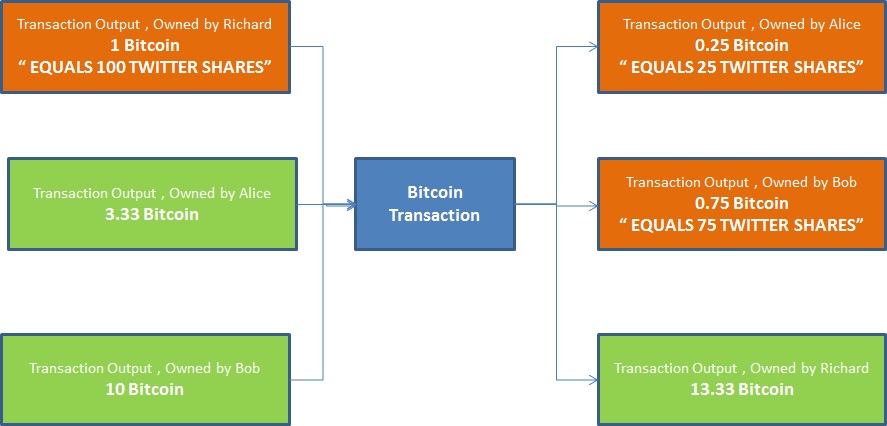
Colored Coin Diagram

In this picture, we see that a Bitcoin transaction has been constructed that has the following interesting properties (in reality, it may be done as a sequence of transactions and I’m not 100% sure you could actually do it this way for real on the current Bitcoin network but the concepts remain the same so we’ll stick with this for the purposes of this post)

  1. Alice and Bob pay their agreed amounts of Bitcoins into the transaction (i.e. their 25% and 75% share of the costs) – colored green in the diagram
  2. I pay in the coin I have previously asserted to be “equivalent” to 100 twitter shares – colored orange in the diagram
  3. Alice and Bob receive 25% and 75%, respectively, of the special (colored) coin so that everybody can now see that they are the owner of the coin, and hence entitled to their shares of any benefits associated with the shares – shown in orange on the right-hand side
  4. I receive Alice and Bob’s payments – shown in green on the right.

Easy, right? Well…. not quite.

The problem is step 3.  If you are an independent third party arbitrating a future dispute, how do you know that the 0.25 XBT and 0.75 XBT received by Alice and Bob relate to the ‘colored’ 1XBT I paid in?  What would have happened if I had also paid somebody else 0.75 XBT in that transaction? How would we know one of these payments was the special colored coin and one was just a regular bitcoin?

Worse, what would happen if Alice or Bob somehow temporarily forgot their coins were special and spent them as if they were normal coins? They could lose a fortune! It would be helpful if their wallet software warned them. Which means the wallet would need to be able to tell automatically. Worse, what if Bob used his colored coin as part-payment for a larger expense, with regular coins making up the difference?  How on earth would the recipient interpret their receipt of a transaction output that was formed from combining colored and non-colored coins?!

The answer is that there is nothing in the core bitcoin system that allows you to tell.  So various conventions have been proposed.  The simplest is one that just relies on ordering, but there are others, none of them particularly satisfactory.  But it’s being worked on.   I think one piece of work in particular has helped in this space by generalising this problem by introducing the idea of a “color kernel“, whose job it is to decide which outputs are related to which types of coin.  Projects such as bitcoinx are working on implementing a system based on these concepts.

In a future post, I’ll discuss a very different model, that of mastercoin.

“A remarkable conceptual and technical achievement”

The Federal Reserve Bank of Chicago has published a rather impressive four-page briefing on Bitcoin.

It does a good job of explaining how the system works and I think is fair in its assessments of the weaknesses.  Worth a read.

If I have one criticism, it is in their use of the word “recursive”. I don’t think that’s hugely helpful as it immediately puts the reader in a “programming” frame of mind and can obscure what’s actually going on. I prefer to explain it by appealing to listeners’ recollections (usually vague!) of inductive reasoning:  “bear with me for a moment and let’s assume the system already works and everybody knows who owns what… right, now let’s work from there and figure out how to spend some coins in a way that allows everybody still to agree afterwards”.  That’s pretty much what they did but I think saying “induction” rather than “recursion” helps the explanatory process.

Where is the power in the mobile payments ecosystem?

I am a member of the UK and Ireland affiliate to the IBM Academy of Technology.  We held our Autumn symposium in Birmingham a few weeks ago and I had the pleasure of hearing about Droplet and meeting one of their management team, David Roberts.

Droplet is a mobile payment system that allows individual to pay merchants using a very simple app, with their unique selling point appearing to be that no other infrastructure is required (no POS terminals, no card readers, …) and that neither the payer nor the recipient is charged for the service.   I’ll leave this aspect of their business model to one side for now as I’m not sure if the details have been publicly disclosed (and it’s not what motivated me to write this post in any case).  What interested me was that it ticks my “push rather than pull” button. I discussed why I like this model here and so I’m always interested in those who are implementing it for real.

Right now, they seem to be targetting local retailers (such as my favourite pizza delivery joint) but it made me wonder: what would it take for a system such as this to be adopted by a major retailer? What are the incentives and game-theoretic chains of logic that help us make sense of this question?

Imagine you’re a major retailer. What are your options?

  • You could build your own system – perhaps licensing technology from a startup such as Droplet – maybe integrating it with your loyalty card system.  But you immediately run into a problem: what incentive does any other retailer have to accept it? They’d surely be extremely wary of ceding control to a competitor. So we have to assume this approach would lead to an arms race, with all major retailers launching their own mobile payment systems. The costs would surely be prohibitive and consumers would surely rebel: would you really want to have to load (and configure and remember the PIN) for tens or hundreds of different apps?   In the ensuing shakeout, perhaps a couple of retailers gain dominance… but if you were CEO of a retailer, how much would you be willing to risk on a bet that you’d be one of the winners?  The odds are against you.
  • Alternatively, the retailer could make a bold statement and adopt a system provided by a neutral third party.  Perhaps a major grocer would simply announce that they will start accepting payments over Droplet or Zapp or in partnership with one of the card networks.  The problem here is: why would you gift an endorsement so valuable to an independent company?  You’d surely be tempted to negotiate a sweetheart deal, which would surely leak and you’d be back to square one: nobody else would want to support it.
  • A different approach might be simply to announce acceptance of multiple systems: let a thousands flowers bloom.  But now you have the problem of consumer confusion and staff training. And staff training will be bad enough with only one option. Indeed, I consider it the most significant inhibitor of a move from “pull” to “push” payments.

For these reasons, I’m increasingly convinced that the optimal response for most major retailers is simply to do nothing! Wait. See how the market plays out. Then be a fast follower.  But I’d love to hear somebody make an argument that says I’m wrong…

Bitcoin: more than a currency

Bitcoin, and the other cryptocurrencies it spawned, are often described as forms of “digital cash”. This is a useful analogy but also obscures an exceedingly important point: all transactions are visible to everybody and in a form that allows the bitcoin units associated with every payment to be tracked for ever more*. This means that Bitcoins are not fungible. This is huge.

It is huge because it means that Bitcoin isn’t just a currency and payment system; it is a globally distributed asset register.

Consider this scenario:

Imagine I own some shares in Facebook. I could publicly announce that a particular Bitcoin (strictly, a transaction output) that I owned actually represented those shares. Thus, somebody who wanted to own these shares could pay me the market price (less a discount, perhaps, to reflect their ongoing counterparty exposure to me) and I would transfer the Bitcoin to them. This transaction would be visible to everybody and anybody aware of my public announcement would know which Bitcoin address now owned those shares.

If Facebook issued a dividend, I would pay it to the Bitcoin address that owned the coin on the relevant date.

The owner could sell it on – and would have no ongoing participation in the scheme – I would be the only entity whose honesty and solvency would need to be relied on.

One could extend this further to encompass other corporate actions and to allow merging and splitting of claims.

Call me a “registrar” or a “custodian” and it’s not a stretch to imagine the Bitcoin architecture forming the basis of a next-generation securities servicing system for the world: is there a whole layer of cost that could be taken out of that industry?

You can go further

Why does the asset have to be a security? Imagine it is a parcel of land or piece of property: now you have a land registry.

This idea of “tagging” Bitcoins so that they have value independent of their currency value is known as colored coins.

The core Bitcoin development team are working on updates to Bitcoin’s design to make this idea easier to implement but, even at a theoretical level, the power is clear.

Coindesk has a nice précis of my interview with Finextra on this topic (scroll down to the third section of the article).

* various mechanisms exist to obscure transactions but they are not relevant to this discussion.

On the blockchain, nobody knows you’re a fridge

I recorded an interview about Bitcoin with Elizabeth Lumley of Finextra last week and it has just gone live.

Richard Bitcoin

I made the point that Bitcoin is clearly going to be huge.  But not for the reasons people commonly suppose.

My take is that, even if it only enjoys modest success as a currency and payment system, that will be sufficient to kickstart a whole other world of innovation.  In particular, ideas such as Colored Coins could enable the emergence of truly secure and tradeable property rights over digital assets and the core insights underpinning Bitcoin’s design have implications for how we build systems for our clients.

I also discussed thow the takedown of Silk Road and how it is likely to legitimise Bitcoin in the eyes of mainstream firms and the possibility that autonomous agents in the “Internet of Things” could become economic agents.

Lessons from Bitcoin: Push versus Pull

Bitcoin is going to change the world – but not for the reasons we commonly assume. One subtle way in which it will change the world is through its influence on other players in the payment ecosystem.

At the heart of the Bitcoin system is the idea of a transaction: at its simplest, this is a transfer of value from one Bitcoin user to another – a credit transfer, if you like.

Consider what this isn’t. This isn’t a direct debit. It isn’t a credit card authorisation. Nor is it the creation of a debt or a precursor to a subsequent billing cycle.  Is is the closest thing we have in the digital world to a person-to-person cash payment.

In this way, we can think of a Bitcoin payment as analagous to a SEPA Credit Transfer, a UK Faster Payments transaction or, more generally, a wire transfer.   Push, not pull.

Graphically, we could depict this as the consumer pushing value directly to the merchant, just like with cash:

Image

Now, consider how that differs to most other forms of electronic payments in the retail space.  They are, almost invariably, achieved through the use of one or more card schemes.

But think about how they work…

The customer thinks they’re paying.  But, really, they’re not. Instead, when they sign the chitty or enter their PIN, they are initiating a supremely sophisticated choreography of immense complexity.

They are, in reality, authorising the merchant to pull the payment from their account, with the request being routed through several intermediaries.

Graphically, it looks something like this:

Image

This model has its advantages but it also suffers from severe problems: the most obvious of which is that if you’re moving payment authorisations around, you need to be maniacally focussed on security: there’s a reason why PCI-DSS exists.

It’s easy to understand why the system was built the way:  what else would you have done with 1960s technology?  The pull model employed by the card processors is a wonder of the world.  But it’s also an artefact of its time.  Would you design it that way if you were starting from scratch today?  I would contend that a system that doesn’t need PCI-DSS, doesn’t need acquirers, doesn’t need issuers, doesn’t need switches and doesn’t require you to trust any third parties has much to commend it.

For this reason, I use this “Push versus Pull” metaphor as a quick heuristic for evaluating payments startups I come across in my day job…