Bitcoin exchanges are more centralised than traditional exchanges. We can do so much better than this.

What The Traditional Financial System Can Teach Us about The MtGox Disaster

Imagine you were an equity trader and used a Stock Exchange to trade between equities and cash and back.  What would happen if they unexpectedly filed for bankruptcy? How much money would you stand to lose? The answer is zero.    You would lose nothing.  Your equities would be safe at your custodian bank and your cash would be wherever you left it.

However, if you were a Bitcoin trader and your Bitcoin exchange went bankrupt, you could have lost everything – as users of Mt.Gox discovered to their cost last week.

How can this be?  Isn’t Bitcoin supposed to be the ultimate decentralized financial system?  Well, yes… the Bitcoin network is decentralized but many of the major players are not.  And, worse, exchanges like Mt.Gox acted as more than just exchanges: they are also the Bitcoin custodian, clearing house and bank.

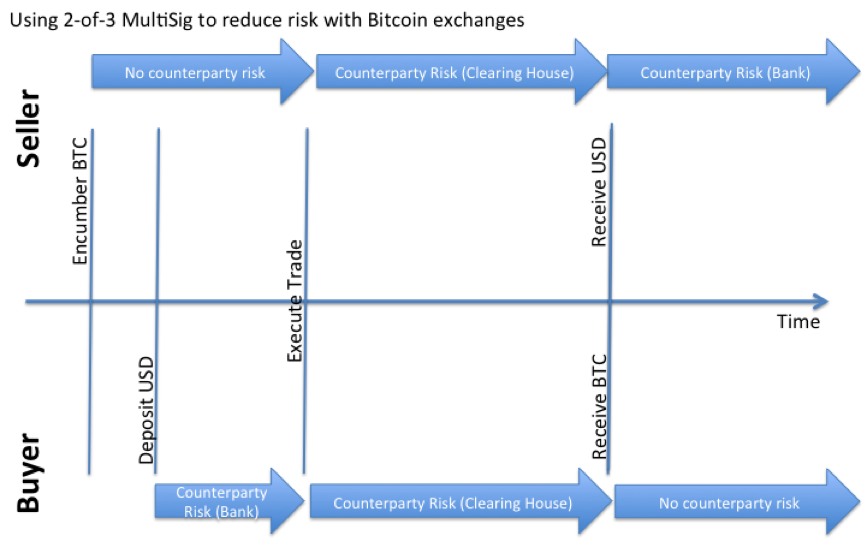
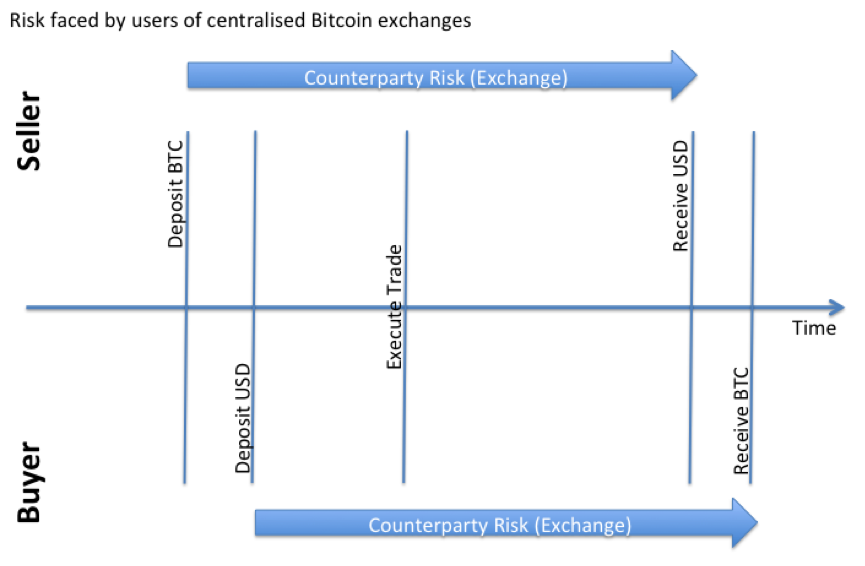
The diagram below shows the problem.  From the time a buyer deposits cash or a seller deposits Bitcoins, they are utterly dependent on the solvency of that exchange until they withdraw their funds at some later date.  You have counterparty exposure to the exchange for all this time.

Pic1

Buyers and Sellers have Counterparty exposure to the exchange for an extended period of time

That’s not how it works in the equity world. I wrote about the mechanics in my article on how equities move around the securities settlement system.

The key point of that article is that your shares and cash never go anywhere near the exchange.

Instead, a custodian bank looks after your equities in a segregated account and they usually also hold your cash.  And a Clearing House will step into the middle of the trade to protect you from non-performance by your counterparty. So you don’t even need to worry about the other party going bust. Things would have to be really bad before you stood to lose any money.

For example, when Lehman Brothers defaulted on US$9 trillion notional of Interest Rate Swap derivatives, LCH.Clearnet (a clearing house) resolved the situation with no loss to anybody else at all:

In September 2008, we successfully managed Lehman Brothers’ US$9 trillion interest rate swap default,  comprising over 66,000 trades, by implementing SwapClear’s unique default management process.   

Less than a week after default, market risk had been reduced by 90% by comprehensive hedging and, within  three weeks, the default was fully resolved well within the margin held and at no loss to other market participants.

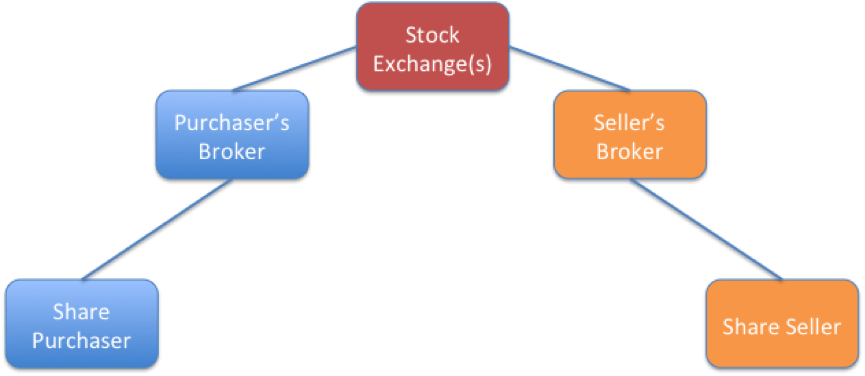
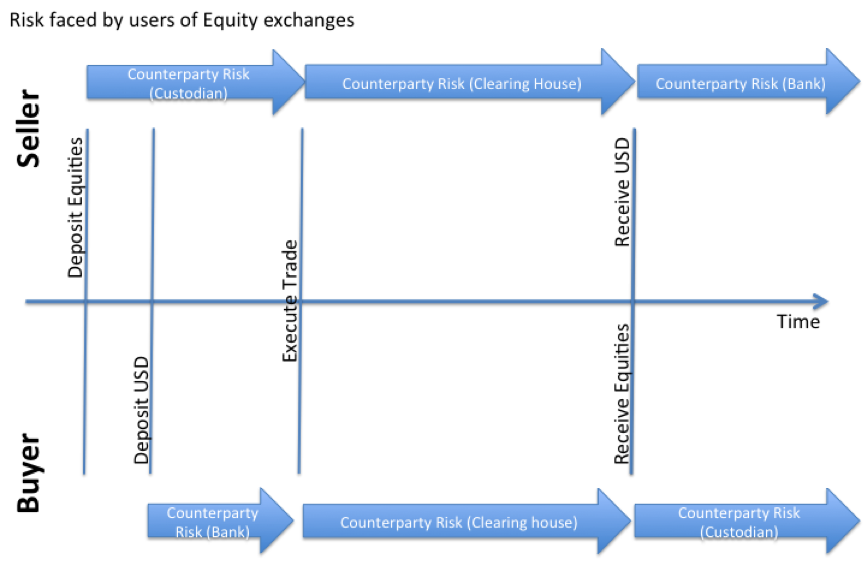
The diagram below shows what the risk situation looks like when trading equities: at no time are you exposed to the exchange’s solvency and that your risk exposure is with respect to well-capitalised, hopefully well-run clearing houses and custodian banks rather than the exchange itself.

Pic2

Users of equity exchanges have no exposure to the exchange

Note that you can choose your custodian and you could, by choosing your exchange, also choose your clearing house….   The equity world is more decentralized than the Bitcoin world!

Can We Do Better?

It’s tempting to conclude that Bitcoin exchanges should move to this model.  But I think we can do better.  Perhaps it is possible to leapfrog a stage of evolution. Here’s what I have in mind:

The Bitcoin “multi-signature” feature allows you to “encumber” funds so that they can only be spent with the agreement of more than one party.   So here’s what you could do if you’re a seller of Bitcoins…

Just before you want to sell some coins through an exchange, send them to a new 2-of-3 address that can be spent by any two of the following three entities:

1)   You

2)   The exchange’s “Clearing House”

3)   An “arbiter” that you and the clearing house both trust

Your coins are now encumbered.  They’re locked up until the trade is done and the outcome agreed.

The “clearing house” would be a new concept in the Bitcoin world but it could be quite simple:  it just needs to be an entity that takes temporary custody of the buyer’s fiat payment and, once received, facilitates the transfer of the Bitcoins, before releasing the fiat payment to the seller.    Note that this still means somebody has to be trusted with the fiat funds but it’s not obvious how you would ever escape from that requirement.  And one could imagine, in the future, that a real Bank might step up to perform this function.

Under this model, when you execute a trade, the exchange informs the clearing house and they then manage the processes necessary to settle the trade.

First, the clearing house can request fiat payment from the buyer (if they don’t already have the funds). When the clearing house confirms to you that they have received payment from the buyer, they sign and submit a 2-of-3 transaction to you for co-signature that will release the encumbered Bitcoins to the buyer.

The clearing house will have populated the buyer’s address and signed their part of the transaction.  So if you agree, you co-sign and publish it into the Bitcoin network.  The recipient gets their Bitcoins, the clearing house waits for confirmation and then releases the cash to you.

At no point does the clearing house or exchange have the ability to steal or lose your coins.  And the 2-of-3 address prevents you from running away with the coins. You all need to co-operate.

In the event of a dispute, you can turn to the third-party “arbiter”, who controls the third key, which they can use to co-sign a transaction with whichever party they decide for.  Notice how there could be competition amongst arbiters – you just need an entity that both you and the clearing house trust.

So provided the arbiter is not in collusion with the clearing house (not a given, of course), we have a way of resolving the transaction even in the event of dispute.

Now this is not perfect and it still has points of centralisation… but it’s a big step forward from where we are today.  And notice how it’s simpler than the equity world: there is no need for a dedicated Bitcoin “custodian” service here – the multi-sig feature allows us to do without.  We just need the clearing houses entities, which could be spun out from the existing exchanges as separate legal entities, and a network of arbiters – the one new function.

From a risk perspective, you end up with the diagram below:

Pic3

Using Multi-Sig transactions as a step towards lower risk (and greater decentralization) for Bitcoin exchanges

 I don’t claim this as an original idea but I think it does have the virtue of being implementable fairly easily (easy for me to say, of course…)

What are the future Bitcoin battlegrounds?

A throwaway remark by Ken Tindell in a conversation with Marc Andreessen and Joseph Weisenthal caught my eye the other day:

It’s a great question:  assume a cryptocurrency like Bitcoin achieves some level of adoption, what happens next? What products and services will be needed? What institutions should we expect to see? Where are the opportunities?

Sadly, that question is just too hard for me.  But I can try answering a different question: what upcoming battles can we foresee that might shape the future landscape?

Here are some thoughts…

What happens when the Banks remember why they exist?

Never Believe What You Read in the Press: People Do Trust Their Bank. Forget this Lesson at your Peril

When I look at an industry, I ask myself: “If it didn’t exist today, would anybody invent it?” It’s instructive to ask that question about retail banks. If I can hold funds on a prepaid debit card, do payments over SMS, get loans from Wonga and invest with Zopa, why do I need a relationship with a bank?

People usually give one of two answers to that question.

The first explanation is to say that Banks exist to facilitate maturity transformation: most people want to borrow long and lend short – and banks are the institutions that meet that demand by taking the other side of the “trade”.  It’s an inherently unstable business but serves a useful purpose so we allow it to exist. Unfortunately, the FinTech revolution and relentless grind of disintermediation makes it look increasingly anachronistic.  So this explanation doesn’t help.

However, there’s an older, simpler model of banking. This model says they exist to look after our stuff.  We deposit our valuables with the bank and they keep them safe.

When I see services like Barclays “CloudIt”, I wonder if we’re seeing a renewed interest in this business model by the banks. And it’s one that could work: despite what they say most people do still trust their banks to look after their stuff. Interest rates on savings are effectively zero and yet people still leave their money with the banks rather than under their matresses or in the stock market. Ignore what people say; look at what they do.

Now look at today’s Bitcoin world. Take me as an example: my Bitcoin holdings are scant yet I barely trust myself to look after them and I’m supposed to be an expert. How is everybody else supposed to manage?  The default solution to this sort of problem is to do what we’ve always done: outsource the problem to specialists.  Today, that might be Coinbase or elliptic or BitGo but if we apply the logic above, would it really be a surprise if banks realized this is also an opportunity for them?

So we can foresee a showdown: what happens if the Banks realize their association with “safekeeping” gives them brand permission to offer Bitcoin wallet services?  Will they create their own offerings? Partner? Acquire?

Who knows… but the point is this: if you assume a valid model for banking is “safekeeping” then Banks could surprise us all and make a claim for a dominant role in Bitcoin’s future.

And I think some people will find that extremely distasteful…

The Mother of All Forks: A Stake Through the Heart of Privacy?

Imagine the banks follow the logic above and they consider offering Bitcoin safekeeping services.  What happens then?  They quickly realize there’s a problem: Anti-Money Laundering and Know Your Customer rules. What do they mean in this world and how do you comply? To be completely safe, they’d want to track your Bitcoin activity closely.

On one level, that’s easy: if they host your wallet, they can see all your Bitcoin transactions.   But they don’t know who you’re transacting with. And they obviously don’t see anything you do with any other wallets.

But they have a way round that: imagine if they said the following:

“We will provide Bitcoin safekeeping services, facilitate the exchange of Bitcoins for sovereign currencies and provide Bitcoin payment services to you provided you agree to identify upon request the identities of any entities with whom you transact. Failure to do so will result in the immediate termination of your account”.

Now, most current Bitcoin users would never sign up to such a condition.  But current users wouldn’t be the target market; the target market would be the mass market… and that is a lot of people.    Now imagine the regulators get involved and insist that Bitcoin exchanges and payment processors insist on similar conditions.

Suddenly, the banking and regulatory sphere has driven a stake through the heart of Hierarchical Deterministic Wallets, Stealth Addresses, CoinJoin and all the rest.  Sure… you can use all those privacy-protecting technologies…. But you just can’t interact with the exchanges or merchants or anybody else in the “real” world.

We could expect a furious backlash and increased focus on decentralized exchanges and other technologies but it’s not hard to imagine a system that is effectively forked: Bitcoins owned by addresses “inside” the system and Bitcoins owned by addresses “outside”.   It’s interesting to imagine which ‘flavour’ of Bitcoin would be worth more…

Robots With Checking Accounts (Silks, Hit the Road?)

If you read the thinking behind projects such as Ethereum, their ambition is stunning:  they foresee whole classes of interaction that today are governed by law that they think can be mapped into code.  What happens to the legal profession in that world?

I don’t think the lawyers need to worry about their jobs just yet, however….  I observed last year that “on the blockchain, nobody knows you’re a fridge”. But  what happens when this becomes a reality?  Is society ready for devices that can initiate and receive financial transactions with their own accounts, accounts to which no human has access?

What does this mean for the legal system? What does “liability” mean in this world? How do you arrest a fridge?

If my fridge detects a design fault in my washing machine and shorts the stock of the manufacturer, is it committing insider trading?


We shouldn’t assume that the best technical solutions will prevail: on “push” versus “pull” payments

I’ve just posted a new piece on the IBM “Insights on Business” platform discussing “push” and “pull” payments.  I point out how push payments, in general, would remove whole classes of threat from the retail payments landscape but that there are some real problems around adoption that may prove insurmountable.

Who will decide the future of retail payments?

Ultimately, we need to remember that consumers actually like their credit cards and most phone-based solutions today are clunky.  So some recent research from Denmark that studied how real people respond to different options is very enlightening.  It’s obvious that we should spend more time thinking about things from users’ perspectives, but difficult to do in reality!

What is the “irreducible core” of Bitcoin?

Or… why is it so hard to come up with a simple, yet accurate, explanation of Bitcoin and its importance?

I am a firm believer in the following rule-of-thumb:

“If you can’t explain something clearly, it means you don’t understand it.”

Put more positively, we could perhaps say:

 “Only when you understand something deeply can you make it sound simple”.

Many of my colleagues will recall situations where I have been almost fanatical in driving for intense clarity of expression. And so it concerns me deeply that there is no good, simple, accurate and comprehensive explanation of Bitcoin that helps people understand what makes it so unique.

Here’s what I mean:  I want a description that doesn’t lead the listener to say:

  • “So how is that different to my electronic bank account?”
  • “So how is that different to airline miles?”
  • “So how is that different to m-pesa?”
  • “So how is that different to Mondex?”
  • “So how is that different to Ripple?”
  • … and so on.

And no cheating is allowed….   You can’t refer to these systems in your description…. Your description has to be so good, it has to be so precise and it has to be so comprehensive that an attentive listener cannot possibly confuse Bitcoin for anything else.  In other words, you need to get to the irreducible core of this bewilderingly complex system.

Here’s a sample of existing explanations that show how hard it is. I typed “What is Bitcoin?” into google.co.uk and clicked on the first five hits:

  • We Use Coins.com
    • The video is helpful but I’m looking for prose that meets my text above.   The closest we get are three boxes that mention “secure”, “open” and “fair”.  These things may or may not be true but they don’t really explain what’s going on
  • Wikipedia“Bitcoin is a peer-to-peer payment system and digital currency introduced as open source software in 2009 by pseudonymous developer Satoshi Nakamoto”
    • OK – perhaps this is accurate but it doesn’t give me any indication that this could be the most important invention of the last decade and an intelligent reader could legitimately confuse it any number of pre-existing centralized systems.
  • The Washington Post“It’s an electronic cash system that allows online payments to be sent directly from one person to another without going through a financial institution (like a bank) or a third party (like PayPal).”
    • This is actually pretty good.  It brings out the “directness” and uses the word “cash” to evoke the idea of a bearer instrument and finality.  But note that it doesn’t tell me anything about how it works or why it’s so revolutionary.
  • Children’s BBC“Bitcoin is a new type of money that is completely virtual. It’s like an online version of cash.”
    • Pretty good – but limited (I’ll go easy on them given their demographic!)
  • Bitcoin.org“Bitcoin is an innovative payment network and a new kind of money.”
    • This is true and is probably enough to pique interest – but you have to go over to the FAQ to get this:
    • “Bitcoin is a consensus network that enables a new payment system and a completely digital money. It is the first decentralized peer-to-peer payment network that is powered by its users with no central authority or middlemen. From a user perspective, Bitcoin is pretty much like cash for the Internet. Bitcoin can also be seen as the most prominent triple entry bookkeeping system in existence.”

Of all these descriptions, I like the last one the best from the perspective of technical accuracy but it focuses only on the “payment” use-case.    For day-to-day usage, I think the Children’s BBC or maybe Washington Post versions are also pretty good.

But did you notice how many concepts were packed into these descriptions, how much knowledge they assumed and how none of them really explained why this was so revolutionary?

I think this is because there are really three independent concepts all competing for attention at the same time and we need to step back to unpack them.

The world’s first internet-scale decentralized platform for value exchange

First, Bitcoin is the world’s first true system of digital cash, which allows peer-to-peer value exchange over the internet with no reliance on third parties.   This is the key feature of Bitcoin as a currency and payment system and explains most of the current infrastructure build-out.

 … implemented on a decentralized global asset register…

Secondly, Bitcoin works because it is based on a new concept: decentralized global asset registers.

Decentralised global asset registers are also an entirely new invention. They can be used to register and transfer ownership of any digital asset.

It is this that people are talking about when they say things like “currency is just the first application” for the Bitcoin platform.

… which is a decentralized consensus system

However, the story doesn’t stop here.  There’s a third element: how do these asset registers work?   They work because of a third breakthrough: the invention of “decentralized consensus systems”.  That is: internet-scale systems that can reach and maintain a common state without the involvement of any third party and in the presence of malignant adversaries.   This is a breathtaking breakthrough in computer science; we should expect to see the most forward-looking computer science schools undertaking active research in this space.

Putting it all together

“Bitcoin is the world’s first system of digital cash, which allows peer-to-peer value transfer over the internet with no reliance on third parties.  It is built on a new invention, the decentralized global asset register. This global asset register is the world’s first decentralized consensus system.”

I’m still working to refine this description, but I think it’s getting close…  although it’s very technical and not suitable for everybody.

Digital Scarcity

Or, at least, I thought was getting close until I listened to this wonderfully informative interview of Adam Back by Andreas M. Antonopoulos on the “Let’s Talk Bitcoin” PodCast.

Adam invented “Hashcash”, the inspiration for Bitcoin’s mining function and contributed to the years of experimentation and prototyping that ultimately led to Bitcoin’s invention.

In the PodCast, he used an interesting phrase.  He described the idea of “digital scarcity”.  That is:  how to create a system that allows you to make objects in the digital world “scarce”.  The obvious intuition here is to think of .mp3 files.  If I email one to you, it hasn’t been transferred, it has been duplicated and is no longer scarce.  We know what happened to the recorded music industry when this happened on an industrial scale.   Back’s concept, thus, is the problem of how to enable transfer without duplication.  Clearly, this property is key to making Bitcoin work and Back’s phrase captures it perfectly: “digital scarcity”.

So, my challenge is to consider how to update my “three concept” model to incorporate this key idea: “digital scarcity”.

Perhaps Digital Scarcity is the irreducible essence….

Is this the single concept that captures what makes Bitcoin so utterly unlike anything that came before?

A Simple Explanation of How Shares Move Around the Securities Settlement System

I explained here how money moves around the banking system and how the Bitcoin system causes us to revisit our assumptions about what a payment system must look like. In this post, I turn my attention to securities settlement: if I sell some shares to you, how do they actually move from my account to yours? What is actually “moving”? What do I mean by “account”? Who is involved? What are the moving parts? 

I have argued for some time that the Bitcoin system is best regarded as a global, decentralized asset register and that some of the assets it could register, track and transfer could be securities (stocks and bonds). In this post, I go back to basics to explain what actually happens behind the scenes today and use that to think through the implications should schemes such as ColoredCoins.org or MasterCoin gain traction. I’ve discussed these systems in a couple of articles here (coloured coins) and here (MasterCoin).

As in the previous article, my focus is on imparting understanding by telling a story and building up a narrative.  This means some of the precise details may be simplified. So please don’t build a securities settlement system for your client using this article as your guide!

First, let’s establish some common ground.

Here are the simplifying assumptions I’m going to make:

  • I’m going to invent a fictional company called MegaCorp
  • I’m going to assume we start back in the days when certificates were in paper form. I’ll move to electronic systems later in the article but I think it helps first to think about paper – it helps us keep track of what’s really going on
  • I’m going to rewrite history to suit the story. If you’re a historian of finance, this article is not for you!
  • Finally, I’m going to assume that MegaCorp already exists, has issued shares and that they are in the hands of a large number of individuals, banks and other firms.  I’m going to assume you’re one of these owners. How these shares were issued would be a fascinating story itself but there isn’t space here to talk about corporate finance, IPOs and all the rest. Google it: “primary market” activity is a really interesting area of investment banking.

So let’s get started. You own some MegaCorp shares and you want to sell them.

Selling shares if everything was paper-based

So… you own some shares in MegaCorp and you have a piece of paper that proves it: a share certificate. You’d like to sell those shares. Now you have a problem. How do you find somebody who is willing to buy them from you?

I guess you could put an advert in the paper or maybe walk around town wearing a sandwich board proclaiming your desire to sell.  But it’s not ideal.

Figure 1 - buyerseller

Figure 1 The fundamental problem: how does a seller find a buyer or a buyer find a seller?

The obvious answer is that it would all be so much easier if there were a place – a venue where people commonly in the business of buying and selling shares could get together and find each other.  Happily, there are and we call such places stock exchanges. In the early days, they were simply coffee houses or under a Buttonwood tree in trading centres such as London. Over time, they became formalized. But the idea is the same: concentrate buyers and sellers in one place to maximize the chance of matching them with each other.

This adds a new box to our diagram: the stock exchange.
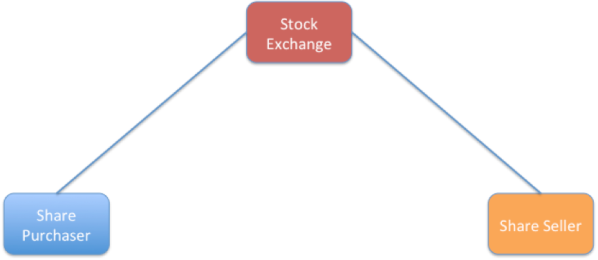
Figure 2 - exchange

Figure 2 A stock exchange brings buyers and sellers together to help them execute trades

There are still some problems, however. What if you’re just an occasional buyer or seller? Do you really want to have to trek to London or New York every time you want to buy or sell? And as an out-of-towner, do you really think you’d get a good deal from the locals who spend all their time there? You’d be completely out of your depth.  So you’d probably value the services of an intermediary – somebody who could go to the exchange on your behalf and get you the best deal they could. We call these people stockbrokers (or just brokers).  An example for retail investors may be Charles Schwab. An example for, say, pension funds might be Deutsche Bank or Morgan Stanley.
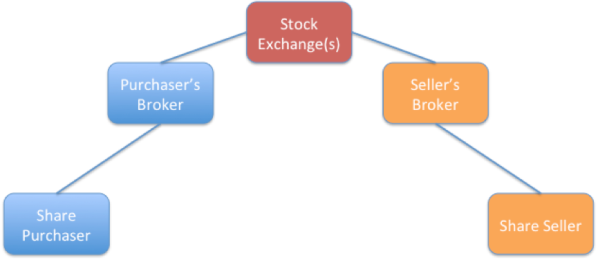
Figure 3 brokers

Figure 3 Brokers act on behalf of buyers and sellers

You’ll notice that “stock exchange” has become “stock exchange(s)”: this reflects the reality that there could be multiple venues you could visit to trade a particular share.  This creates opportunities for arbitrage (the price may be different at each venue) but we’ll ignore this from now on.

Now this works fine if there is lots of trade in MegaCorp shares: when my broker tries to sell, there will probably be somebody else who wants to buy.  But what happens if there are no buyers just then? Does that mean the share is worthless? Clearly not. So there’s an opportunity to somebody to make a living taking a bit of risk by buying and selling shares on their own account. Whereas a broker is acting in an agency capacity, this new person would make money from their wits: buying low and selling high with their own money. We call these people market-makers – since they literally create a market in the shares in which they specialize. We call firms like Goldman Sachs and Morgan Stanley broker-dealers because some of their subsidiaries engage in both broking and market-making in various markets.
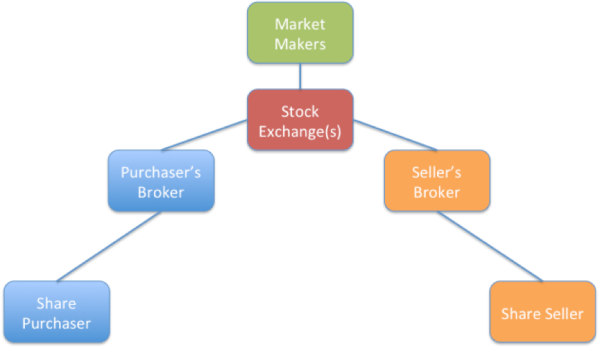
Figure 4 market makers

Figure 4 Market-makers buy and sell shares on their own account, creating liquidity

Guess what: we still have problems! Remember: I’ve asked my broker to sell my shares for me but imagine they succeed.  Then what? We now have the tricky problem of settlement.  Remember: we’re still in the days of paper-based certificates.  So my broker has just sold my MegaCorp shares. Well… the buyer is going to want the certificate pretty soon.  And I would quite like the cash.

Now… I could just trust my broker.  I could leave the paper certificate in their hands and ask them to take receipt of the cash when the buyer’s broker hands over their cash.  But that means placing a lot of trust in that individual. And remember: I chose the broker because they could navigate the rough and tumble of the stock exchange, not because I trusted their book-keeping skills!

Worse, what happens if MegaCorp issues a dividend while the share certificate is in the hands of the broker? Do they really have the ability or inclination to collect the divident, allocate it to my account and report to me about this in a timely manner? Perhaps, but probably not.

But we still have the need for somebody to keep the certificate safe and to be on hand to give it to the purchaser if a sale takes place. It’s just that the skills needed by this person are completely different to those needed by the broker.  The broker needs to be able to negotiate the best price for me. But the person who looks after my certificate needs to be good with accounts, book-keeping, reporting and security.  After all, I’m trusting them with the safekeeping of my share certificate: it’s in their custody.  So we call these people custodians. Examples include State Street and Northern Trust, as well as divisions of Citi and HSBC, etc.
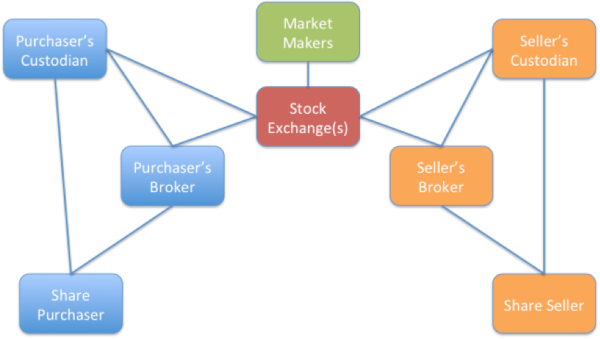
Figure 5 custodians

Figure 5 Custodians are responsible for the safekeeping of shares

So now, when my broker finds a willing buyer at the exchange, they can tell my custodian to expect to receive cash from the buyer’s custodian and to send the certificate to the buyer’s custodian when this happens.

And while the share certificate is sitting at the custodian, they can deal with all the tedious things that can happen to a share during its life: dividends, stock-splits, voting, …  It’s as if the shares need regular attention, like an old car that needs constant servicing: so we call this business the business of securities servicing.  The picture above shows a line from the buyer/seller to their custodians, because the custodian is working on their behalf. However, retail investors will probably not be aware of this relationship as their brokerage will manage the relationship on their behalf.

So… what have we achieved?  I can lodge my share certificate with a custodian, instruct my broker to sell the shares on my behalf by finding a willing buyer at a stock exchange and wait for the cash to arrive. We’re done!

Erm… not so fast.  There are still several problems.    The first becomes obvious when you think about how the picture I’ve described would work in practice. You have loads of brokers shouting at each other, making trades all the time. It would be completely chaotic yet, somehow, we need to get to a point where the buying and selling brokers agree completely on the details of the trade they just did and have communicated matching settlement instructions perfectly to the two custodians so they can settle the trade.  That’s not going to be easy.

In reality, there’s quite some work that must be done post-trade to get it to the point where it can be settled (matching, maybe netting, agreement of settlement details, agreeing on time and place of settlement, etc, etc).  We call this process clearing. (I wrote previously about a real-life example of spontaneous clearing at the world’s first-ever open-outcry Bitcoin exchange.)

And there’s a second, more subtle, problem: how does my broker know that the person they’re selling to is good for the cash? And how does the buyer know that my broker can lay their hands on the shares? In the model I’ve just described, they don’t.  Now, perhaps that’s not a problem: after all, smart custodians are only going to exchange shares and cash at the same time.  But it’s still problematic: sure… if the buyer turns out not to have the cash, I still have my shares… but I wanted to sell them! And the price may drop before I can find a replacement buyer.

A clearing house is intended to solve both these problems. Here’s how: after a trade is matched (both sides agree on the details), the information is sent to the clearing house by the exchange. And here’s the trick: as well as orchestrating the clearing process and getting everything ready for settlement, the clearing house does something clever: it steps into the middle of the trade.  In effect, it tears up the trade and creates two new ones in its place: it becomes my buyer and it becomes the seller to the buyer.  In this way, I have no exposure to the buyer: if they turn out to be a fraud, it’s now the clearing house’s problem.  And the ultimate seller has no exposure to me: if I turn out to be a fraud, the buyer still gets their shares (the clearing house will go into the market and buy them from somebody else if it really has to).  We call this “stepping in” process novation and say that the clearing house is acting as a central counterparty if it performs this service. As an example, the London Stock Exchange uses LCH.Clearnet Ltd as its clearing house.

Of course, this amazing service comes at a price: they charge a fee and, more importantly, impose strict rules on who can be a clearing member of the exchange and how they should be run. In this way, the clearing house acts as a policeman, ensuring only people and firms with a good track record and deep resources are allowed to participate. (I’ll leave to one side whether this privileging of one group over another is a net good or bad!)

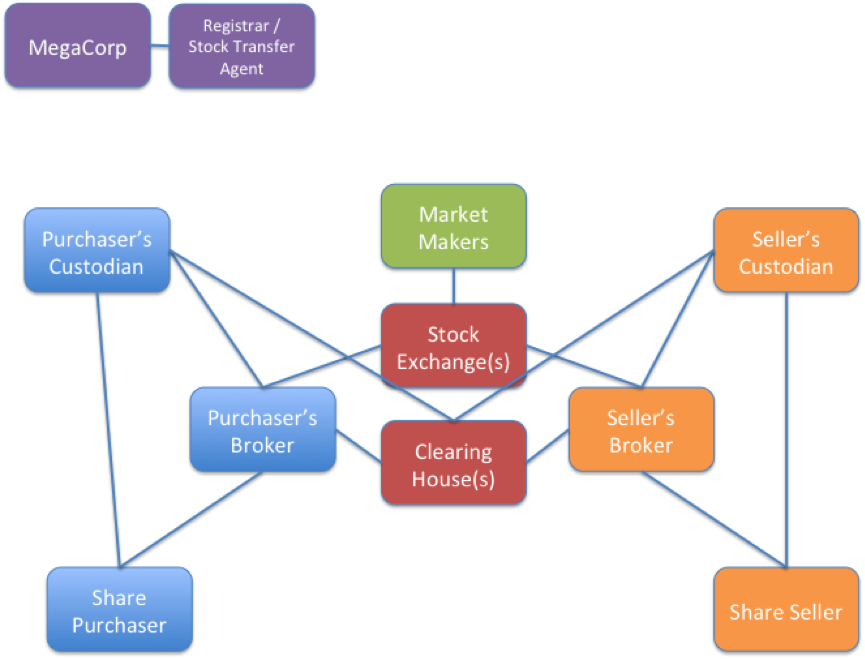
So we can update our picture again:
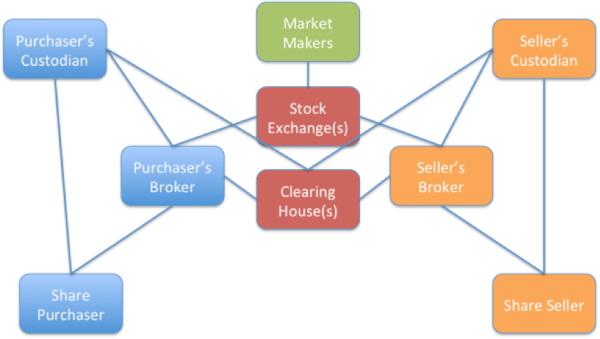
Figure 6 clearing house

Figure 6 A clearing house manages the post-trade process of getting to a point where settlement can take place and often also acts as a central counterparty

We’re almost there… but there are still some loose ends.  To see why, consider this from MegaCorp’s perspective.  We’ve been talking about buying and selling their shares and this all happens without any involvement from them at all.  That’s fine in most circumstances but it does cause problems from time to time. Specifically, what happens when the company issues a dividend or wants its shareholders to vote on something?  How does it know who its shareholders are?  Imagine it knew I was a shareholder.  What happens after I’ve sold the shares using the system above to somebody else? How does the company get to hear about the new owner?

Enter yet another player: the registrar (UK) or share transfer agent (US). These companies work on behalf of the company and are responsible for maintaining a register of shareholders and keeping it up to date. If the company pays a dividend, these companies are responsible for distributing it.  They rely on one of the participants in the process to tell them about share transfer. An example of a registrar in the UK would be Equiniti.

Figure 7 registrar

Figure 7 A registrar (or stock transfer agent) keeps track of who owns a company’s shares on behalf of the company

Now, I assumed up front that we were using paper certificates. And it’s amazing how far you can go in the description without needing to bring IT into the narrative at all.  But, clearly, paper certificates are a complete pain.  They can get lost, you have to move them around, you have to reissue them if the company does a stock split, etc.  It would clearly be easier if they were electronic.

For any given custodian, it’s not a problem: they can just set up an IT book-keeping system to keep track of the share certificates under their safekeeping.  And this can work well:  imagine if the seller of a share uses the same custodian as the buyer: if the custodian is electronic, no paper needs to move at all! The custodian can just update its electronic records to reflect the new owner.  But it doesn’t work if the buyer and seller use different custodians: you’d still need to move paper between them in this case.

So this raises an interesting possibility: what if we had a “custodian to the custodians”?  If the custodians could deposit their paper certificates with a trusted third party, then they could transfer shares between each other simply by asking this “custodian to the custodians” to update its electronic records and we’d never need to move paper again!

And that’s what we have.  We call these organisations central securities depositories.  In the early days, they were just that: a depository where the share certificates were placed in exchange for an equivalent entry on the electronic register. The shares were, in effect, immobilized at the CSD.  Over time, people gained trust in the system and agreed that there really wasn’t any need for paper certificates at all… so we moved from immobilization to dematerialization.  The UK’s CSD is Euroclear (CREST).

This completes our picture (and notice how it is the CSD who informs the registrar when shares change hands… left as an exercise to a reader is thinking through what happens if shares change hands within the same custodian and what it means for the granularity of the data held by registrars):
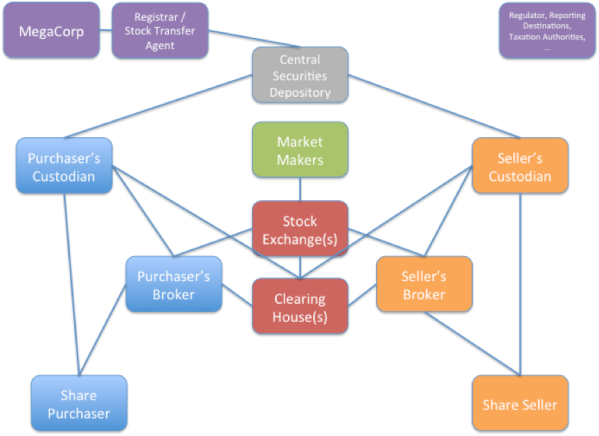
Figure 8 csd

Figure 8 A CSD acts as the “custodian to the custodians”

This picture also introduces regulators, governments and taxation authorities, for completeness. However, I don’t discuss them here. I also don’t discuss what happens if you’re trading shares cross-border.

So now we have the full story: if I want to sell some MegaCorp shares, here’s what happens:

  • My shares start off in the account of my broker, who uses a custodian for safekeeping
  • The broker executes a sale at an exchange
  • The clearing house establishes everybody’s respective liabilities, steps in as central counterparty and orchestrates the settlement process
  • The buyer’s and seller’s custodians exchange shares for cash (“Delivery versus Payment”), utilizing the CSD if shares need to move between custodians as a result. Assuming so, the company’s registrar is informed.
  • Somebody probably has to pay some tax J

You’ll notice many parallels with the global payments system: lots of intermediaries and lots of specialists – all of them there for a reason but imposing costs nonetheless.

Now, I said I would use this narrative to discuss what it could mean for Bitcoin “colored coins”.  I think there are two key concepts that can help us think through workable models: risk and the meaning of settlement.

Risk

Consider the picture above: what risks are you exposed to as an investor? Ideally, if you buy shares in MegaCorp, the only risks you want to be exposed to are those associated with MegaCorp itself, realized through changes in share price or dividend payments. So, the ideal state is when you just face this market risk.  And that’s broadly what the system above delivers: by depositing your shares in a custodian bank, which should keep them in a segregated account at the CSD, you’re protected even if the custodian goes bust: your shares are not considered part of the custodian bank’s assets. So the only risk you’re exposed to beyond the market risk (which you want) is operational risk that the custodian makes a mistake. (I’ll ignore cash here but note that it’s typically not protected in the same way)

Now, when we look at “colored coin” share representation schemes, we see there is the notion of a colored coin “issuer”: somebody who asserts that a given set of coins represents a particular number of shares in a particular company.  So now we have a big question: who is this somebody?  This matters because if the “somebody” reneges on their promise or goes bust, you’ve lost your shares.

Now, if a colored coin scheme were “grafted on” to today’s system, it could work quite well if done right.  Imagine a firm wanted to offer colored coins representing 100 MegaCorp shares. They could open a custody account, fund it with 100 MegaCorp shares as “backing” and we’d be done: such firms could perhaps compete on the completeness of their transparency.  However, owners of colored MegaCorp coins would have counterparty exposure to this firm, which means the risk profile would be different (worse?) than if they simply owned coins in a regular custody account.

Interestingly, you can’t overcome the problem entirely by having a custodian bank be the issuer because it’s not obvious to me that a coloured MegaCorp coin issued by a custodian bank is the same as a segregated share for the purposes of bankruptcy protection: you’d presumably also need a legal opinion – and I am not a lawyer!

Bottom line: there is work to do for those developing these schemes.

However, there is one intriguing possibility with this approach: think through what happens if MegaCorp themselves were to issue colored coins representing their shares. Any analysis of counterparty risk becomes moot: if MegaCorp went bust, you’d lose your money regardless of how your shares were held!  Perhaps this is the future?  (Note also that I’m not discussing here precisely why anybody would want to issue – or buy – coloured coins! I’ll leave that to others)

Do you actually want settlement?

However, there’s another way of looking at this: you don’t have to own a share to enjoy the benefits of ownership. Contracts for Difference (or, more generally, Equity Swaps) allow you to enjoy the losses or gains from owning a stock without actually owning it. They are, instead, contracts, with a counterparty, in which the counterparty pays (or receives) cash that matches the gain or loss in the share price (and payment of dividends).   Now, the counterparty often hedges their risk by buying the shares – but that becomes their problem, not yours. So this gives you all the benefits of owning the stock without having to go through the pain of actually taking delivery. It also has tax advantages in some jurisdictions.

The downside is that you take on counterparty risk to the party issuing the CFD: if they go bust while you’re in the money, you’re out of luck.  But we’ve already established that there could well be quite considerable counterparty risk with colored coins in any case. So perhaps this is the right model.  I don’t yet have a view on which will prevail but hopefully laying out how today’s system is constructed will help others think this through more clearly.

I’ll end with one final observation: the issuance is the easy part.. but somebody still has to do the servicing.  But notice how this is much easier if you use a technology such as the Block Chain: there’s no need for the arbitrary distinctions between custodian, CSD and registrar:  the issuer can see immediately which addresses own their coins and to whom they should send messages or dividends.  Similarly, the peer-to-peer nature of Bitcoin means the hierarchy of custodians and CSDs could possibly be collapsed.

I know many people think blockchain technology could be hugely disruptive for the world’s banks but I look at it another way: I believe there are huge opportunities for those financial firms that really take the time to study this space.

[Final comment: a reminder to readers that this is my personal blog and the opinions are mine alone… I don’t speak on behalf of my employer]

[Update – 2014-01-07 – One question I failed to address above is precisely why anybody would want to settle share trades using a coloured coin scheme! I think there are two possible answers:

1) if settlement can be effected over the blockchain, the cost potentially reduces to the fee of the Bitcoin transaction in simple cases

2) if opens up the potential for custodians, CSDs and registrars/stock transfer agents to innovate their business models in a new way: do they still need to be separate entities, for example? Further, would ‘regular’ companies see value in becoming their own issuers, etc?

However, I’m not convinced this approach does anything to reduce risk – the challenge would be how to build a system with risk as good as what we have today. ]
The world’s first open outcry Bitcoin exchange and what it teaches us about clearing

I attended BitcoinExpo 2013 in London this weekend.   There were some very interesting talks and I met some great people. I thought there was perhaps a little too much focus on speculation, mining and trading but perhaps that’s just evidence of the maturity of the Bitcoin scene in the UK. Give it time.

That said, even I  couldn’t resist going along to the world’s first ever open outcry Bitcoin exchange.   In the bar of 93 Feet East on Brick Lane, Paul Gordon, a former trader, assembled a group of fifteen or so wannabe Bitcoin traders from amongst the attendees at the conference and created something rather special.

OpenOutcry#1

He explained the rules of the pit, taught everybody the hand gestures, ran a couple of trial runs and then trading began for real.  What I found so fascinating was that all the elements were there:

  • There were buyers: they used “pulling” hand gestures to indicate that they were quoting a price at which they would buy a “lot” of 0.01 Bitcoins (that is: they were quoting a “bid”)
  • There were sellers: they used “pushing” hand gestures to indicate that they were quoting a price at which they would sell (they were quoting an “offer”)
  • There were market-makers: these are people who quoted both a price at which they would buy and at which they would sell
  • There was a short-seller: he borrowed coins from somebody else, which he promptly sold into the market
  • There was a short squeeze: towards the end of the trading session, the other traders all knew he needed to buy back the coins he had sold short (to return to the original owner) and he suddenly found the price moving against him
  • … and there was a lot of paper: once each trade was struck, both parties to the trade filled out pieces of paper with the details of the trade (how many lots, at what price, with whom)

OpenOutcry#2

But what most interested me was what happened once the trading was over: there was then a spontaneous process of clearing.

Clearing

In financial markets, clearing is the process of figuring out who owes what to whom and agreeing how they’re going to settle their obligations to each other.  You can think of it as being everything that needs to happen after a trade is agreed to get it to the point where assets can change hands. And that’s exactly what we saw happen here:

  • First, we saw trade matching: the parties to trades compared their paper slips with each other to make sure they agreed on the details of the trade
  • I also saw some evidence of trade netting: parties who had both bought and sold from each other realised they could cancel out certain trades, just paying the cash difference in the value of the trades
  • And I saw people discussing the mechanics of settlement: how exactly where they going to exchange their pounds and send their Bitcoins?

This is exactly what happens in a regular process of clearing in other, far more formal markets, such as the equity markets – and I thought it was fascinating to see it emerge spontaneously. Of course, clearing for a market such as the London Stock Exchange or in New York is somewhat more complicated than this. In particular, the role of a clearing house to support the concept of novation for netting is very important and the real-world model is hierarchical (involving Central Securities Depositories, Custodian Banks and lots of other players). But the essential character is the same.

In short, the core principles of clearing emerged spontaneously on a Saturday afternoon in a bar on Brick Lane. Amazing.

A simple explanation of how money moves around the banking system

Twitter went mad last week because somebody had transferred almost $150m in a single Bitcoin transaction. This tweet was typical:

There was much comment about how expensive or difficult this would have been in the regular banking system – and this could well be true.  But it also highlighted another point: in my expecience, almost nobody actually understands how payment systems work.  That is: if you “wire” funds to a supplier or “make a payment” to a friend, how does the money get from your account to theirs? 

In this article, I hope to change this situation by giving a very simple, but hopefully not oversimplified, survey of the landscape.

First, let’s establish some common ground

Perhaps the most important thing we need to realise about bank deposits is that they are liabilities. When you pay money into a bank, you don’t really have a deposit. There isn’t a pot of money sitting somewhere with your name on it. Instead, you have lent that money to the bank. They owe it to you.  It becomes one of their liabilities. That’s why we say our accounts are in credit: we have extended credit to the bank.  Similarly, if you are overdrawn and owe money to the bank, that becomes your liability and their asset.  To understand what is going on when money moves around, it’s important to realise that every account balance can be seen in these two ways.

Paying somebody with an account at the same bank

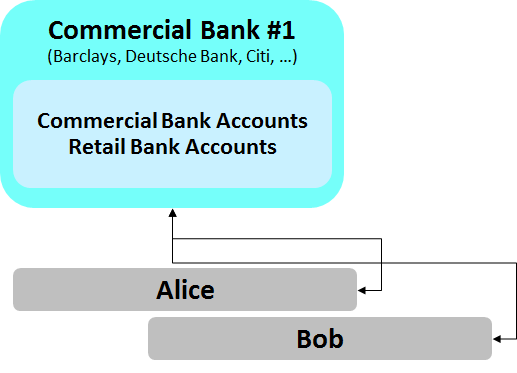
Let’s start with the easy example. Imagine you’re Alice and you bank with, say, Barclays. You owe £10 to a friend, Bob, who also uses Barclays. Paying Bob is easy: you tell the bank what you want to do, they debit the funds from your account and credit £10 to your friend’s account.  It’s all done electronically on Barclays’ core banking system and it’s all rather simple: no money enters or leaves the bank; it’s just an update to their accounting system.  They owe you £10 less and owe Bob £10 more. It all balances out and  it’s all done inside the bank: we can say that the transaction is “settled” on the books of your bank.  We can represent this graphically below: the only parties involved are you, Bob and Barclays.  (The same analysis, of course, works if you’re a Euro customer of Deutsche Bank or a Dollar customer of Citi, etc)

Single Bank Settlement

But what happens if you need to pay somebody at a different bank?

This is where it get more interesting.  Imagine you need to pay Charlie, who banks with HSBC. Now we have a problem: it’s easy for Barclays to reduce your balance by £10 but how do they persuade HSBC to increase Charlie’s balance by £10?  Why would HSBC be interested in agreeing to owe Charlie more money than they did before?  They’re not a charity! The answer, of course, is that if we want HSBC to owe Charlie a little more, they need to owe somebody else a little less.

Who should this “somebody else” be?  It can’t be Alice: Alice doesn’t have a relationship with HSBC, remember.  By a process of elimination, the only other party around is Barclays. And here is the first “a ha” moment…  what if HSBC held a bank account with Barclays and Barclays held a bank account with HSBC? They could hold balances with each other and adjust them to make everything work out…

Here’s what you could do:

  • Barclays could reduce Alice’s balance by £10
  • Barclays could then add £10 to the account HSBC holds with Barclays
  • Barclays could then send a message to HSBC telling them that they had increased their balance by £10 and would like them, in turn, to increase Charlie’s balance by £10
  • HSBC would receive the message and, safe in the knowledge they had an extra £10 on deposit with Barclays, could increase Charlie’s balance.

It all balances out for Alice and Charlie… Alice has £10 less and Charlie has £10 more.

And it all balances out for Barclays and HSBC.  Previously, Barclays owed £10 to Alice, now it owes £10 to HSBC. Previously, HSBC was flat, now it owes £10 to Charlie and is owed £10 by Barclays.

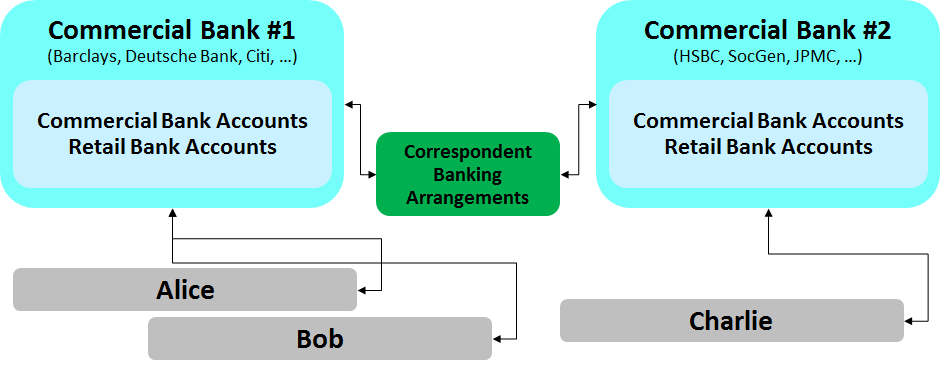
This model of payment processing (and its more complicated forms) is known as correspondent banking. Graphically, it might look like the diagram below.  This builds on the previous diagram and adds the second commercial bank and highlights that the existence of a correspondent banking arrangement allows them to facilitate payments between their respective customers.

Correspondent Banking

This works pretty well, but it has some problems:

  • Most obviously, it only works if the two banks have a direct relationship with each other. If they don’t, you either can’t make the payment or need to route it through a third (or fourth!) bank until you can complete a path from A to B. This clearly drives up cost and complexity. (Some commentators restrict the use of the term “correspondent banking” to this scenario or scenarios that involve difference currencies but I think it helpful to use the term even for the simpler case)
  • More worryingly, it is also risky. Look at the situation from HSBC’s perspective.  As a result of this payment, their exposure to Barclays has just increased.  In our example, it is only by £10.  But imagine it was £150m and the correspondent wasn’t Barclays but was a smaller, perhaps riskier outfit: HSBC would have a big problem on its hands if that bank went bust.  One way round this is to alter the model slightly: rather than Barclays crediting HSBC’s account, Barclays could ask HSBC to debit the account it maintains for Barclays. That way, large inter-bank balances might not build up. However, there are other issues with that approach and, either way, the interconnectedness inherent in this model is a very real problem.

We’ll work through some of these issues in the following sections.

[Note: this isn’t *actually* what happens today because the systems below are used instead but I think it’s helpful to set up the story this way so we can build up an intuition for what’s going on]

Hang on… why are you making this so complicated? Can’t you just say “SWIFT” and be done with it?

It is common when discussing payment systems to have somebody wave their hands, shout “SWIFT” and believe they’ve settled the debate.  To me, this just highlights that they probably don’t know what they’re talking about 🙂

The SWIFT network exists to allow banks securely to exchange electronic messages with each other. One of the message types supported by the SWIFT network is MT103. The MT103 message enables one bank to instruct another bank to credit the account of one of their customers, debiting the account held by the sending institution with the receiving bank to balance everything out.  You could imagine an MT103 being used to implement the scenario I discussed in the previous section.

So, the effect of a SWIFT MT103 is to “send” money between the two banks but it’s critically important to realise what is going on under the covers: the SWIFT message is merely the instruction: the movement of funds is done by debiting and crediting several accounts at each institution and relies on banks maintaining accounts with each other (either directly or through intermediary banks).  Simply waving one’s hands and shouting “SWIFT” serves to mask this complexity and so impedes understanding.

OK… I get it. But what about ACH and EURO1 and Faster Payments and BACS and CHAPS and FedWire and Target2 and and and????

Slow down…..  Let’s recap first.

We’ve shown that transferring money between two account holders at the same bank is trivial.

We’ve also shown how you can send money between account holders of different banks through a really clever trick: arrange for the banks to hold accounts with each other.

We’ve also discussed how electronic messaging networks like SWIFT can be used to manage the flow of information between banks to make sure these transfers occur quickly, reliably and at modest cost.

But we still have further to go… because there are some big problems: counterparty risk, liquidity and cost.

The two we’ll tackle first are liquidity and cost

We need to address the liquidity and cost problem

First, we need to acknowledge that SWIFT is not cheap. If Barclays had to send a SWIFT message to HSBC every time you wanted to pay £10 to Charlie, you would soon notice some hefty charges on your statement.  But, worse, there’s a much bigger problem: liquidity.

Think about how much money Barclays would need to have tied up at all its correspondent banks every day if the system I outlined above were used in practice. They would need to maintain sizeable balances at all the other banks just in case one of their customers wanted to send money to a recipient at HSBC or Lloyds or Co-op or wherever.  This is cash that could be invested or lent or otherwise put to work.

But there’s a really nice insight we can make:  on balance, it’s probably just as likely that a Barclays customer will be sending money to an HSBC customer as it is that an HSBC customer will be sending money to a Barclays customer on any given day.

So what if we kept track of all the various payments during the day and only settled the balance?

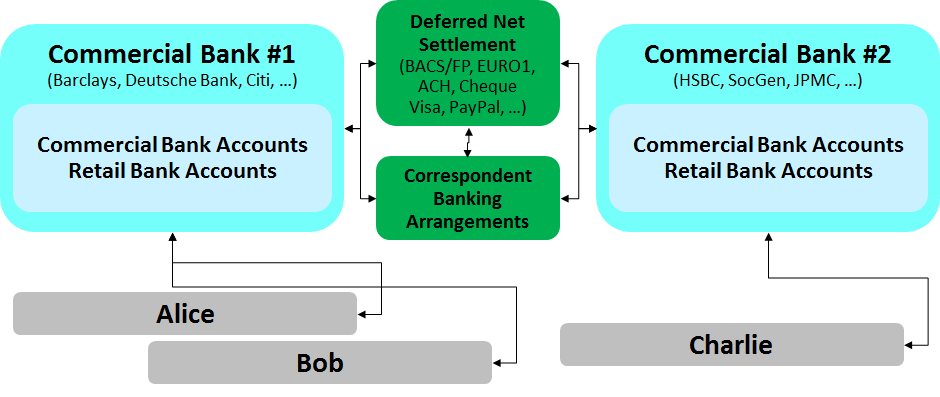
If you adopted this approach, each bank could get away with holding a whole lot less cash on deposit at all its correspondents and they could put their money to work more effectively, driving down their costs and (hopefully) passing on some of it to you.  This thought process motivated the creation of deferred net settlement systems.  In the UK, BACS is such a system and equivalents exist all over the world.  In these systems, messages are not exchanged over SWIFT.  Instead, messages (or files) are sent to a central “clearing” system (such as BACS), which keeps track of all the payments, and then, on some schedule, calculates the net amount owed by each bank to each other.  They then settle amongst themselves (perhaps by transferring money to/from the accounts they hold with each other) or by using the RTGS system described below.

This dramatically cuts down on cost and liquidity demands and adds an extra box to our picture:

Deferred Net Settlement

It’s worth noting that we can also describe the credit card schemes and even PayPal as Deferred Net Settlement systems: they are all characterised by a process of internal aggregation of transactions, with only the net amounts being settled between the major banks.

But this approach also introduces a potentially worse problem: you have lost settlement finality. You might issue your payment instruction in the morning but the receiving bank doesn’t receive the (net) funds until later.  The receiving bank therefore has to wait until they receive the (net) settlement, just in case the sending bank goes bust in the interim: it would be imprudent to release funds to the receiving customer before then.  This introduces a delay.

The alternative would be to take the risk but reverse the transaction in the event of a problem – but then the settlement couldn’t in any way  be considered “final” and so the recipient couldn’t rely on the funds until later in any case.

Can we achieve both Settlement Finality and Zero Counterparty Risk?

This is where the final piece of the jigsaw fits in.    None of the approaches we’ve outlined so far are really acceptable for situations when you need to be absolutely sure the payment will be made quickly and can’t be reversed, even if the sending bank subsequently goes bust.  You really, really need this assurance, for example, if you’re going to build a securities settlement system: nobody is going to release $150m of bonds or shares if there’s a chance the $150m won’t settle or could be reversed!

What is needed is a system like the first one we outlined (Alice pays Bob at the same bank) – because it’s really quick – but which works when more than one bank is involved.  The multilateral bank-bank system outlined above sort-of works but gets really tricky when the amounts involved get big and when there’s the possibility that one or other of them could go bust.

If only the banks could all hold accounts with a bank that cannot itself go bust… some sort of bank that sat in the middle of the system.  We could give it a name.  We could call it a central bank!

And this thought process motivates the idea of a Real-Time Gross Settlement system.

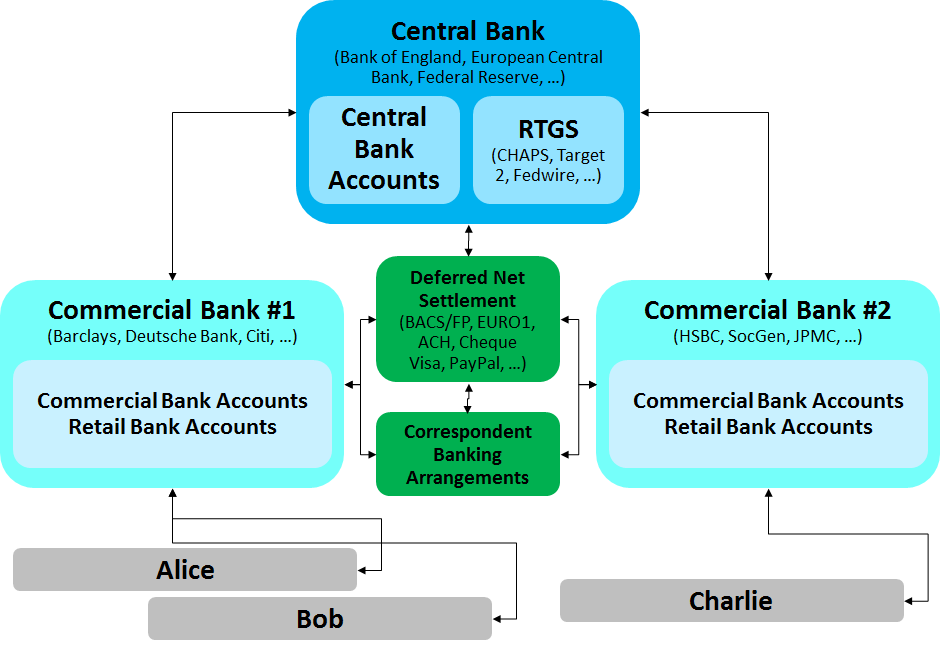
If the major banks in a country all hold accounts with the central bank then they can move money between themselves simply by instructing the central bank to debit one account and credit the other.  And that’s what CHAPS, FedWire and Target 2 exist to do, for the Pound, Dollar and Euro, respectively. They are  systems that allow real-time movements of funds between accounts held by banks at their respective central bank.

  • Real Time – happens instantly.
  • Gross – no netting (otherwise it couldn’t be instant)
  • Settlement – with finality; no reversals

This completes our picture:

RTGS

I thought this article had something to do with Bitcoin?

Well done for getting this far.  Now we have a question: can we place Bitcoin on this model?

My take is that the Bitcoin network most closely resembles a Real-Time Gross Settlement system. There is no netting, there are (clearly) no correspondent banking relationships and we have settlement, gross, with finality.

But the interesting thing about today’s “traditional” financial landscape is that most retail transactions are not performed over the RTGS. For example, person-to-person electronic payments in the UK go over the Faster Payments system, which settles net several times per day, not instantly.   Why is this?  I would argue it is primarily because FPS is (almost) free, whereas CHAPS payments cost about £25.  Most consumers probably would use an RTGS if it were just as convenient and just as cheap.

So the unanswered question in my mind is: will the Bitcoin payment network end up resembling a traditional RTGS, only handling high-value transfers?  Or will advances in the core network (block size limits, micropayment channels, etc) occur quickly enough to keep up with increasing transaction volumes in order to allow it to remain an affordable system both for large- and low-value payments?

My take is that the jury is still out: I am convinced that Bitcoin will change the world but I’m altogether less convinced that we’ll end up in a world where every Bitcoin transaction is “cleared” over the Blockchain.

[Updated several times on 25 November 2013 to correct minor errors and to add the link to my Finextra video at the end]

On Bubbles and Architecture… or the importance of the letter ‘s’

I was amused by the juxtaposition of two tweets in my timeline this morning.

Ron Tolido, Cap Gemini’s CTO for Application Services, implied that Bitcoin is a bubble:

Right below him was a series of comments by Andreas Antonopoulos, of which this is typical:

They can’t both be right.   Or can they?

My take is that yes they can.  And the reason is because Bitcoins are not the same as Bitcoin.

Bitcoins are currency units that can be owned and transferred using the Bitcoin network. Today, they trade for, say, $600 and their exchange rate with other currencies is, currently, very volatile.   Ron is quite right to imply that we have no idea what one Bitcoin is worth and, regardless of what a “fair” value might be, one can expect a violently random walk on the path to that value.    Frankly, it’s a mug’s game trying to predict it and it is my intent never to comment, speculate or otherwise comment on this side of things.  It simply isn’t all that interesting.  And I think Ron is right to inject some calm into the debate (this post is not a criticism of him!)

But I think that he may also have rather missed the point.  The innovation of Bitcoin isn’t the creation of a new asset class or a get-rich-quick scheme – Bitcoins as a currency are just one application for the core technology of the Bitcoin network.

And as an architect, it is this underlying architecture that I am focussed on: the underlying genius of Bitcoin is the invention of a globally distributed and decentralised digital asset register, enabled through a stunning breakthrough in computer science: distributed consensus.  It is an open platform for money, if you like.

And I think that is the key insight:  in public debate, we need to distinguish between a particular application of the Bitcoin network and the network itself.

In other words, think of Bitcoins – the Bitcoin currency – as like a dotcom stock.   Perhaps it is amazon.com.  But it could also be pets.com.  Who knows.  Frankly, who cares?

But the Bitcoin network, should be thought of as analogous to the world-wide web itself:  the enabling technology.

The lesson I take from history is that it was the platform that changed the world – and that’s why my focus is on the bitcoin network, not the random gyrations of the bitcoin currency.

(Disclosure:  I never thought I’d have to write this but the recent price moves mean that, notwithstanding all the discussion above, I feel honour bound to disclose that I own a very small number of bitcoins.)

Decentralised Digital Asset Registers – Mastercoin

In my previous post, I discussed how one might build a decentralised asset register on top of Bitcoin. However, there is another approach, one taken by mastercoin. There is a very good explanation of how the system works by Vitalik Buterin at Bitcoin magazine. What makes this approach interesting is that it is based on a deep insight: the bitcoin network and the bitcoin currency are not the same thing.

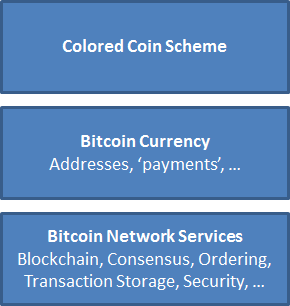
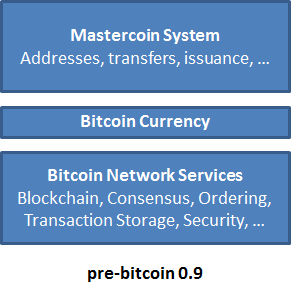
They don’t describe it this way, but what I think is going on is that they have implicitly said that we can think of Bitcoin itself as the core network (providing consensus services, storage of transactions, etc) and a currency and payment system that sits on top. The colored coin shemes I described in my last post can be thought of as providing a third layer above these. Graphically, we might draw it like this:

colored sheme

The key insight of mastercoin is that you could also build a distributed asset register on top of the network services, without making much use of the bitcoin currency itself.  That is: whereas a bitcoin transaction and a colored coin transaction are really the same thing, a mastercoin transaction could have no real conceptual linkage to the underlying bitcoin transaction that happens to carry it. It would, in effect, be a second currency system sitting on the same network infrastructure.

Unfortunately, the bitcoin network doesn’t provide the generalised storage facilities that this approach requires and the current mastercoin implementation feels, to me, like a hack. For example, bitcoin addresses are repurposed to represent concepts other than addresses in a really quite unsatisfactory way. An ingenious solution to the problem but still a hack 🙂    This means that they haven’t quite managed to remove the middle box in the diagram above and the result is an uneasy half-way house.

mastercoin1

However, once a seemingly minor change to allow 80-bytes of arbitrary data in a bitcoin transaction is introduced in bitcoin 0.9, it may be possible to implement a far more elegant implementation of mastercoin. In essence, their architecture might herald a wave of alternative schemes that sit on the core bitcoin network.

mastercoin3

I have no idea which approach will prevail (economics will no doubt trump architectural purity, as ever!) but it is great to see so much innovation in this space.